
USDT fees across networks: comparison and how to choose a network
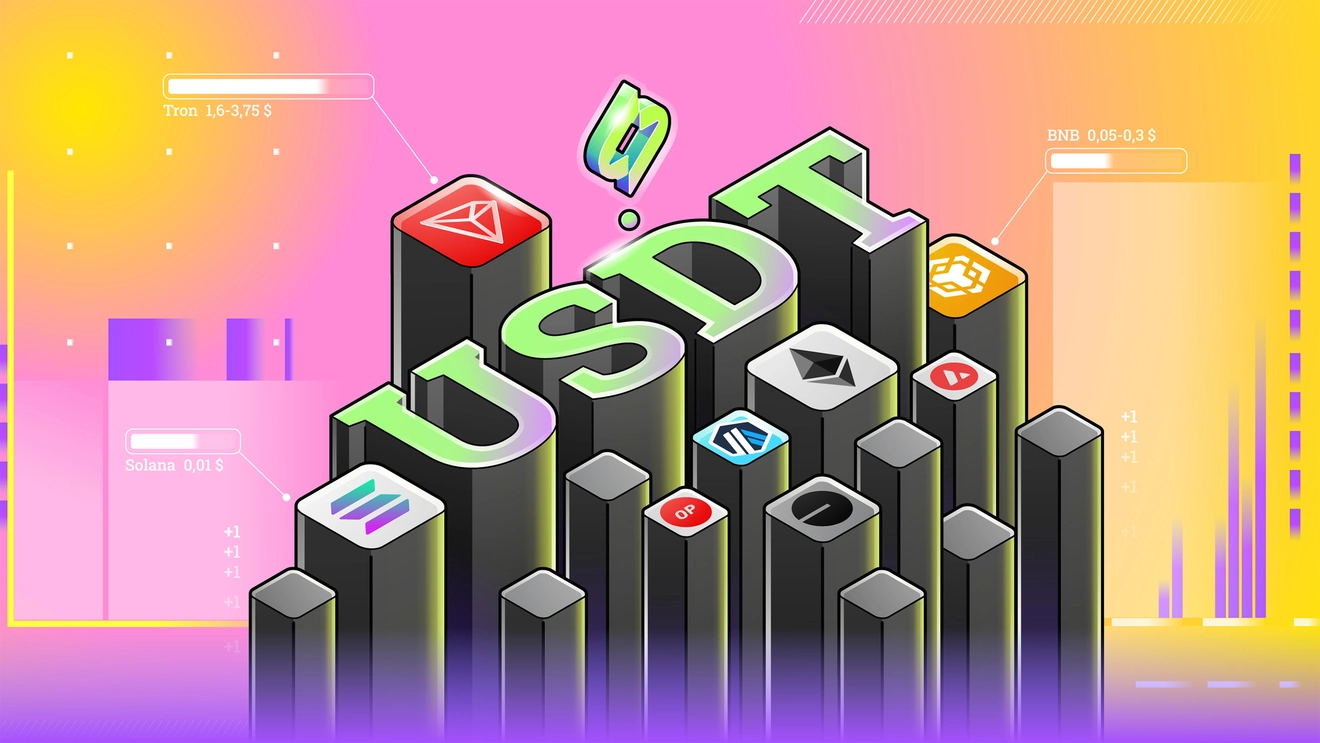
USDT is the most popular stablecoin in the world. Millions of people use it for transfers, savings, and trading. But many don’t realize that USDT is not just a single token – it’s a whole family of tokens. USDT exists on different networks and standards (ERC-20, TRC-20, BEP-20). It’s the same stablecoin by value, but transfer conditions differ – speed and fees depend on the chosen network.
One token – many networks
Tether issues USDT on many blockchains. There is USDT on Ethereum – it’s called ERC-20. There is USDT on TRON – that’s TRC-20. There is USDT on BNB Chain – BEP-20. There are also versions on Solana, Polygon, Arbitrum, Avalanche, Toncoin, and others.
Technically, these are different tokens. They live in separate ecosystems and don’t “understand” each other. But by value, 1 USDT is equal to 1 USD everywhere. When you choose a network for a transfer, you’re choosing only the delivery method.
Main rule: you cannot transfer USDT from one network to another directly. You can’t send a TRC-20 token to an ERC-20 address. If the sending network and the receiving network don’t match, the transfer won’t be credited, and the funds will be lost. That’s why both sender and receiver must choose the same network.
Fee comparison across popular networks
USDT fees vary significantly across networks. We collected data актуальные for early 2026. Fees are shown in USD per transaction.
|
Network |
Token type |
Average fee, $ |
Speed |
|
TRON |
TRC-20 |
1.6–3.75 |
5–15 seconds |
|
Ethereum |
ERC-20 |
3–9 |
1–10 minutes |
|
BNB Chain |
BEP-20 |
0.05–0.30 |
10–30 seconds |
|
Polygon |
ERC-20 |
0.01–0.05 |
30–120 seconds |
|
Solana |
SPL |
0.01 |
5 seconds |
|
Arbitrum |
ERC-20 |
0.15–0.40 |
1–2 minutes |
|
Optimism |
ERC-20 |
0.20–0.50 |
1–3 minutes |
|
Base |
ERC-20 |
0.05–0.15 |
30–120 seconds |
|
Avalanche |
ERC-20 |
0.10–0.30 |
30–120 seconds |
The table clearly shows the spread – from near-free transfers on Solana to expensive transactions on Ethereum.
A closer look at each network
TRON (TRC-20). The most popular network for USDT. Costs on TRON depend on its resource model: Energy (for smart contracts) and Bandwidth (for basic operations). If you don’t have enough resources, the network compensates by burning TRX. At the moment, a TRC-20 transfer costs 6.5 TRX (~$1.86) when sending to an address that already has USDT, and 13.1 TRX (~$3.75) when sending to a new wallet. TRC-20 is no longer the cheapest option, but it remains one of the most widely used.

Ethereum (ERC-20). The base ecosystem for many tokens and DeFi apps, but fees can be high due to demand and gas mechanics. ERC-20 makes sense if the recipient supports only Ethereum, or if the transfer is tied to apps inside the Ethereum ecosystem.
BNB Chain (BEP-20). A strong option. Fast, cheap, supported by all major exchanges. Transfer fees are low.
Polygon. A great balance of price and speed. Especially popular in DeFi.
Solana. A leader in speed and low fees. The fee is less than a cent. But not every exchange supports USDT on Solana, so check in advance.
Arbitrum, Optimism, Base. These are Ethereum L2 networks. They keep Ethereum’s security model while offering lower fees. Adoption has been growing quickly.
Avalanche. A fast and relatively inexpensive alternative to Ethereum.
Which network is the cheapest for USDT
If you look only at the numbers, the cheapest networks for USDT are Solana, Polygon, BNB Chain, and L2 networks. Fees there are measured in cents or fractions of a cent.
But low cost is not the only criterion. You must check which network the recipient supports. You can find the cheapest network in the world, but if your counterparty uses only TRC-20, there’s no alternative.
For mass transfers between exchanges, TRON still leads. Yes, it’s more expensive than Solana, but it’s supported almost everywhere. Binance, Bybit, OKX, Huobi – all work with TRC-20. It’s an industry standard.
Basic steps for a safe USDT transfer
A step-by-step checklist for a safe transfer:
- Confirm the recipient’s network. Before copying the address, ask the person or check on the exchange which network is required. This is the most important step.
- Check the fee. Before confirming the transaction, the exchange will show the exact amount to be charged. Make sure you’re okay with it.
- Copy the address instead of typing it manually. One wrong character can mean permanent loss of funds.
- Do a test transfer for large amounts. Send $1 first and confirm everything works.
- Save the TxID. This is the transaction ID. You can track status in a blockchain explorer.
- Make sure you have native tokens. If you send from a personal wallet, ensure you have ETH, TRX, BNB, or SOL to pay the network fee.
Key recommendations
For transfers between exchanges. Use Tron (TRC-20) or BNB Chain (BEP-20). These networks are widely supported, fast, and reasonably priced.
For DeFi activity. Consider Polygon, Arbitrum, or Base. Fees are low and the app ecosystem is large.
For maximum savings. Choose Solana, but verify the recipient supports it.
For new users. Don’t chase ultra-low fees on obscure networks. It’s better to pay $2 on TRC-20 than to lose the whole amount due to a network mismatch.
-
Why did the TRC-20 fee rise to $1.86 if it used to be lower?
The TRC-20 fee depends on the TRX price and the cost of energy. TRX went up in price, so the fee became higher in USD terms. In TRX, it is still 6.5 TRX for a regular transfer.
-
Can I transfer USDT from ERC-20 to BEP-20 directly?
No. A direct transfer between different networks is not possible. You can do it only via bridges or exchanges, but that is a separate operation with its own fee.
-
Which network is the safest for USDT?
Ethereum is often considered the safest due to high decentralization and a long track record. But for a standard transfer, the security level of Tron or BNB Chain is usually sufficient as well.
-
Why does the withdrawal fee on exchanges often differ from the real network fee?
Exchanges add their own fee on top. They can round up or set a fixed withdrawal fee. Always check the final amount before confirming.
-
What happens if I send USDT on the wrong network?
Другие статьи
Перейти в блог

Every transaction
without FeeSaver — is an overpayment
Connect your addressright now and start saving!
Комментарии (0)