
TRON Energy vs Bandwidth: Comparison and Cost Examples

When people first start using the TRON blockchain, they quickly run into two unfamiliar terms – Energy and Bandwidth. No transaction works without them. But why does the network need two separate resources, how do they differ, and how much do they cost?
In the TRON network, Energy and Bandwidth are two different resources used to pay for blockchain operations. Bandwidth covers data transmission and storage on the network, while Energy is consumed when executing smart contracts. Simple TRX transfers usually require only Bandwidth, while USDT TRC-20 transfers and other smart contract operations also require Energy. That is why transaction costs on TRON can vary significantly depending on the type of operation.
How Bandwidth and Energy differ on the TRON network
Imagine that the TRON blockchain is a large factory. The factory has a conveyor belt and complex machines.
Bandwidth is the conveyor belt. It moves boxes with goods. Any box takes up space on the belt. It does not matter what is inside – one dollar or a thousand. Only the size of the box matters.
Energy is the electricity for complex machines. The factory turns on a machine, it runs a program, makes calculations, and performs work. That requires energy. The more complex the program, the more energy is needed.
In TRON terms, a simple TRX transfer is just a box moving along the conveyor belt. It only needs Bandwidth. Sending USDT is the launch of a complex machine. It needs both energy for execution and space on the conveyor belt for the result.
Bandwidth and Energy usage in typical operations
Bandwidth is measured in transaction bytes. One byte of data equals one unit of Bandwidth. Sending TRX uses about 268 units. Sending USDT uses about 345 units. The transfer amount does not matter. The transaction size stays roughly the same.
Energy is measured in units of computational load. A USDT transfer usually requires significantly more resources than a simple TRX transfer. Depending on the address type and the recipient's state, Energy consumption can vary noticeably.
This is the core difference between Energy and Bandwidth. Bandwidth is responsible for data transfer, while Energy is responsible for computation. When smart contracts are involved, one cannot replace the other.
How much Bandwidth and Energy cost when resources are insufficient
The cost of resources is different. One unit of Bandwidth costs 1,000 sun (0.001 TRX) when burned. One unit of Energy costs 100 sun (0.0001 TRX). At first glance, Energy seems ten times cheaper. But in practice, you need hundreds of times more of it.
Let's look at some examples:
- TRX transfer. It requires 268 Bandwidth. No Energy is needed. If there are no resources available, 0.268 TRX will be burned.
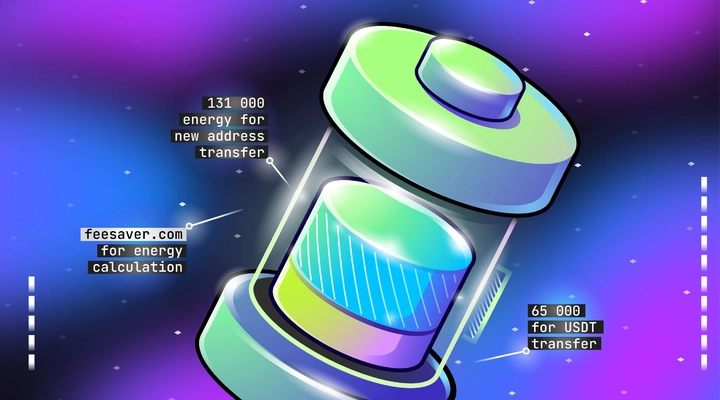
- USDT transfer to a regular address. It requires 345 Bandwidth and 65,000 Energy. Burning cost: 345 × 0.001 = 0.345 TRX for Bandwidth, plus 65,000 × 0.0001 = 6.5 TRX for Energy. Total: about 6.85 TRX.
- USDT transfer to a new address. It requires 131,000 Energy. That means 13 TRX for Energy alone, plus the same 0.345 TRX for Bandwidth. Total: about 13.35 TRX.
That is why transaction fees on TRON can vary so much. The cost depends not on some arbitrary network markup, but on how many resources are required for a specific operation.
How to get Bandwidth and Energy on TRON
Only Bandwidth is available for free. Each account receives 600 units per day. That is enough for two TRX transfers or one USDT transfer with a small amount left over. But Energy cannot be obtained for free.
TRX staking. You freeze coins and receive a share of the global resource pools. The total Bandwidth pool is 43.2 billion per day. The Energy pool is 180 billion. The larger your share, the more resources you receive each day.
If you freeze 5,000 TRX, you will get about 8,000 Bandwidth and around 46,300 Energy per day. The Bandwidth is enough for 50–60 transactions. The Energy only covers about two-thirds of one USDT transfer.
To fully cover one USDT transfer per day with staking-based Energy, you need to freeze roughly 6,900–7,100 TRX. That gives about 65,000 Energy per day, which is exactly what is needed for one transfer to an address that already holds the token.
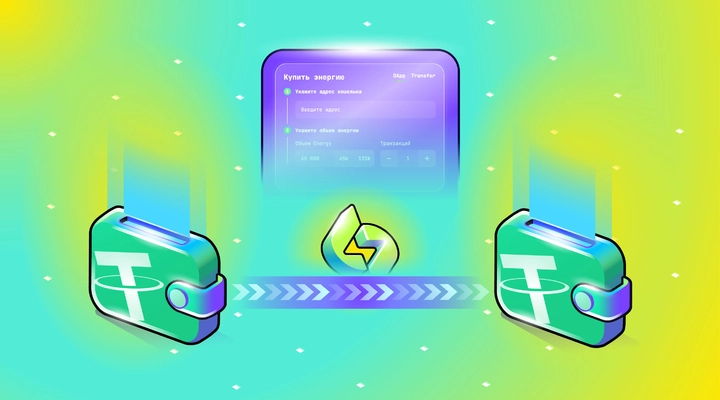
Energy rental. This is the most popular option for users who do not want to freeze TRX. You pay 3–5 TRX per transaction and receive ready-to-use Energy or Bandwidth. Your coins remain liquid. You can trade them, transfer them, or use them however you want.
Which option is more cost-effective
Let's calculate using real numbers. Assume TRX = $0.286.
- Burning. One USDT transaction to a regular address costs 6.5 TRX. That is $1.86. One hundred transactions cost $186 per day, or $5,580 per month.
- Energy rental. One transaction costs 3–5 TRX. That is $0.86–$1.43. One hundred transactions cost $86–$143 per day, or $2,580–$4,290 per month.
- Staking. You freeze 7,000 TRX, about $2,002, and receive Energy at no extra cost. Transactions cost nothing. But the coins are locked. They can be withdrawn only 14 days after the unstake request.
Energy rental is beneficial for all types of users, whether they make one-off transfers or send transactions regularly. Savings on transaction costs can reach up to 80%.

Staking is suitable for users who send USDT in large volumes every day and are ready to keep their coins locked.
The practical difference between Bandwidth and Energy
The difference between Bandwidth and Energy becomes especially noticeable at the moment a transaction is sent.
If a user transfers TRX, usually only Bandwidth is consumed. If the available amount is insufficient, the missing part is covered by burning TRX.
If a user transfers USDT TRC-20, the operation requires not only Bandwidth but also Energy. That is why expenses for such transactions are higher when resources are insufficient. In practice, the user may not notice the difference in advance and may only see it when TRX is deducted to cover the missing resource.
For that reason, before sending USDT it is useful to check the available Energy balance in advance and understand how the transaction will be processed – through the free limit, staked resources, rented resources, or TRX burning.
Conclusion
Bandwidth and Energy on TRON are responsible for different types of network load. Bandwidth is needed for data transfer and basic operations, while Energy is required for executing smart contracts. That is why a regular TRX transfer is cheaper, while a USDT TRC-20 transfer usually involves additional costs. If you make transfers regularly, it makes sense to choose a suitable way to obtain resources in advance: staking, rental, or direct coverage through TRX burning.
-
Can you send USDT if you only have Bandwidth but no Energy?
A USDT (TRC-20) transfer requires both resources – Energy and Bandwidth. If there is not enough Energy, the network will try to cover the missing amount by burning TRX. If the limit is still insufficient, the transaction will fail, for example with an OUT OF ENERGY error.
-
Why does a TRX transfer not require Energy?
Because a TRX transfer is a simple operation that does not execute a smart contract. It only writes data to the blockchain, so Bandwidth alone is enough.
-
Which recovers faster – Bandwidth or Energy?
Both resources recover according to the same principle. Full recovery takes 24 hours. The process is continuous and happens with each new block. After 12 hours, roughly half of the spent resources will be restored. Note: there is free daily Bandwidth, 600 units per account, while Energy is only available through staking.
Другие статьи
Перейти в блог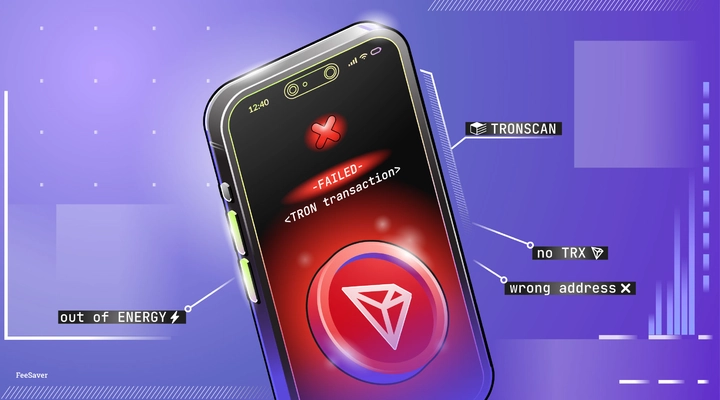

Every transaction
without FeeSaver — is an overpayment
Connect your addressright now and start saving!
Комментарии (0)